
Technological innovations and trends from Russia World Cup 2018 to 2025
GRASSENGINE -James Leung| July 2025

Introduction: the birth of an unexpected innovation
Bellingham, Gallagher, Saka… These familiar names all have one thing in common: they all play with the same winning formula: Cut-hole football socks. Maybe in 2025 Cut-hole football socks are as commonplace as they come, but as far back as the 2018 World Cup in Russia, their appearance has left viewers in front of their TV sets in a state of consternation: “Why are players wearing a pair of torn socks on the pitch?”
The 2018 World Cup in Russia not only provided the world with a wonderful football feast, but also left a landmark moment in the history of sports equipment – the first appearance of Cut-hole football socks in a world-class competition. This seemingly simple equipment DIY has triggered a chain reaction from functional needs to fashion trends, profoundly affecting the development trajectory of modern football equipment.
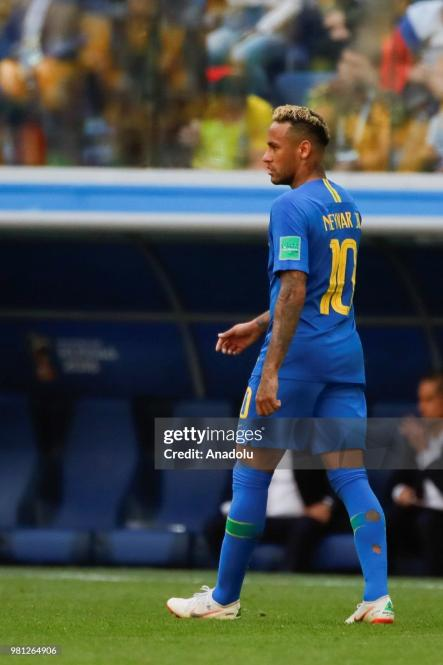
Neymar of the Brazilian national team was one of the early adopters. As early as in the group stage of the Brazil-Costa Rica match, the media noticed that Neymar’s socks had two big holes in them, which coincided with Neymar’s frequent being tackle or malicious foul on the field, and even the emergence of the famous “Neymar roll”, so people thought that the hole in the sock was caused by a malicious foul. The big holes in his socks were the result of an assault.
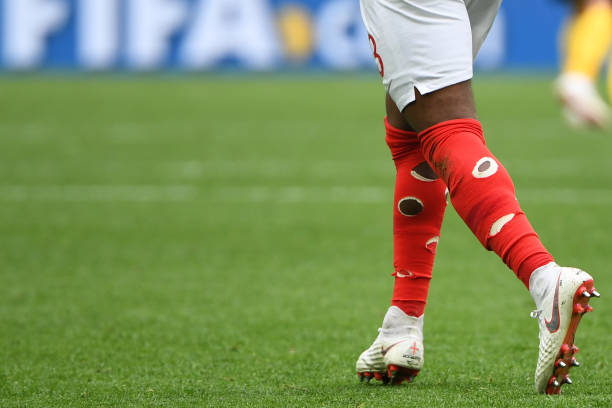
England national team’s Danny Rose in the World Cup third-fourth place final on 13 July 2018 for the first time in the socks full of holes not caused by the fierce confrontation, but the player voluntarily cut with scissors to open the hole. And his team-mate Kyle Walker followed Rose’s lead in adopting hole-opening socks. There are two key functional needs behind this behaviour:
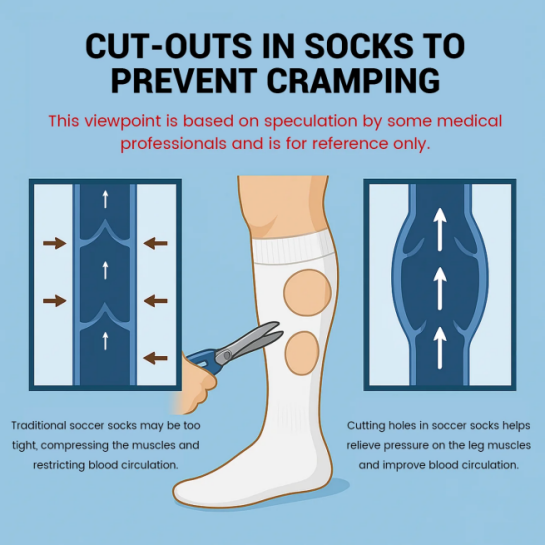
- Relief of muscle compression: the official socks were too tight causing pain and even cramps in the calves in the second half
- Circulation optimisation: players believed the holes would improve blood flow and enhance sporting performance
Despite being fined nearly $140,000 twice by FIFA for using non-sponsored socks, England insisted on allowing their players to play “sock-breaking”, highlighting the players’ urgent need for functionality.
Five players have “DIY” their own socks for the 2018 World Cup in Russia, including Brazil’s Neymar, England’s Danny Rose and Kyle Walker, Poland’s Milik and Tunisia’s Ben Alouane.
From controversy to trend: Cut-hole football socks in full swing
In contrast to the sporadic cases of the 2018 World Cup, Cut-hole football socks are now commonplace in professional football. Here are key comparisons between 2018 and 2025:
| Contrasting dimensions | 2018 World Cup in Russia | Status quo in 2025 |
| Scope of prevalence | Individual players (Ross, Neymar, etc.) | Bellingham, Saka, Gallagher and hundreds of other players |
| Industry response | No specialised product, players cut their own holes | GRASSENGINE patented pre-cut socks launched, brand co-branded models launched |
| Tournament regulation | Fines for non-compliance | La Liga and other leagues acquiesce to health needs and relax restrictions. |
Star effect drives scale
Bellingham, Saka continued to cut-holes in their socks for the 2022 World Cup and Real Madrid, attracting players like Ferran Torres and Diaz to follow suit, creating the “Bellingham trend“. Nowadays, cutting your own holes in football socks may not necessarily be because they are too tight for your muscles, but also because you are imitating Bellingham, Gallagher and other players, and this top-down spreading pattern has greatly accelerated the popularity of Cut-hole football socks. In the 23/24 and 24/25 seasons of the Premier League, there are already as many as 65 people wearing open socks, accounting for 12.3% of the total number of players.

The industrial chain takes shape
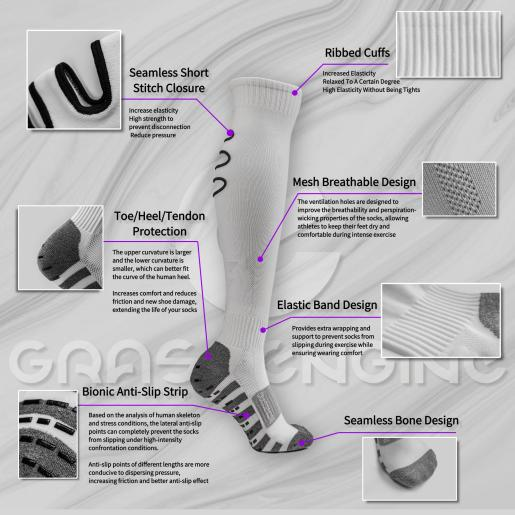
- Patent design: International brand GRASSENGINE has applied for the patent of no-cut Cut-hole football socks (US29966038, EU015093436-0001, UK6454764, CN309277597S), with pre-set holes to solve the problem of hand-cutting and damaging socks, and inaccuracy of the cutting holes.
- Brand co-branding entry: Umbro and Slam Jam co-operate to launch hole-breaking design trend socks, transforming functional needs into fashion symbols
- Rise of emerging brands: international brand GRASSENGINE has launched professional hole-opening socks, which are being rapidly promoted worldwide, popularising hole-opening football socks all over the world.
Compromising the rules of the game
Although La Liga has a “no torn jerseys” rule, it has relaxed the restriction for the sake of players’ health, only requiring the replacement of torn jerseys/pants, and tacitly permitting the use of open socks. This adaptation of the rules reflects the governing body’s recognition of the physiological needs of the players.
Scientific Controversy and Functional Verification
he medical community is significantly divided on the actual efficacy of Cut-hole socks:
“Cutting holes reduces flounder muscle pressure, promotes natural muscle expansion, improves blood flow and reduces fatigue. This is not a psychological effect but has physiological value.”
— Sports Medicine Specialist, Logroño Hospital
Supporting viewpoints
Sports medicine experts state that cutting holes significantly reduces flounder muscle pressure, promotes natural muscle expansion, improves blood flow and reduces fatigue. Several experts have stated that it is “non-psychological and has physiological value”.
Skeptic’s point of view
Physiotherapists believe that there is a lack of rigorous medical evidence and that compression socks are supposed to help recovery by increasing pressure, so opening holes may be counterproductive. Sporting goods expert Mayo pointed out that the elasticity of top brand socks is already excellent, and the hole effect may be psychological comfort.
From functional fix to cultural symbol: a paradigm shift in the history of football equipment
The evolution of hole-opening socks reveals the core logic of modern football equipment development:
2018: driven by functional needs
Temporary measures by players to relieve muscle pressure (Ross cut socks)
2022: Group imitation
Group behaviour led by Bellingham, Gallagher and other players
2024: commercialisation of the industry
Patenting and commercialisation of companies (GRASSENGINE brand)
2025: Cultural symbols
Fashion brands give cultural significance (Umbro co-brand)
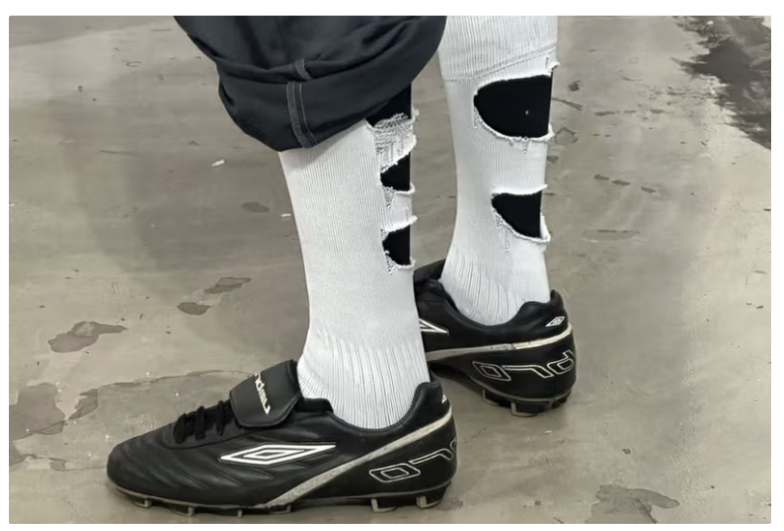
This process highlights how individual athlete practice is forcing industry upgrades and reshaping sports science topics – doctors have called for more biomechanical research on hole-breaking socks. The global journey of the sock, from the green fields of Russia to the Bernabeu of Real Madrid, is a testament to the rule that in sport, “the pain point is the starting point for innovation” – with every cut, a player writes an unexpected and insightful footnote in the history of modern football equipment.
© 2025 GRASSENGINE-James Leung | This report is based on real match data and industry research.
*Data sources: FIFA Technical Reports, Player Interviews, GRASSENGINE Official Database, Patent Database, Sporting Goods Market Analyses*